Zoom Udp Connections Little Snitch
Posted : admin On 13.01.2021- Zoom Udp Connections Little Snitch Free
- Zoom Udp Connections Little Snitch Game
- Zoom Udp Connections Little Snitch Lyrics
- Zoom Udp Connections Little Snitch 2
Blocking Outbound Connections with Little Snitch. The firewall in Mac OS X is designed to stop incoming connections. When youire connected to the Internet directly, and your IP address is visible, hackers can generally see your Mac and construct a variety of attacks. Ive just upgraded my Little Snitch firewall (major update) and Im getting periodic incoming Connections on openvpn blocked. On 12 Jul 2017, 94.229.74.90 tried to establish an incoming connection to openvpn on UDP port 59573. The request was denied automatically because this kind of incoming conne. Monitoring all connections is an extremely low overhead process. It's what home router QoS configs do in real-time, with additional packet analysis and queue prioritization, all on their teensy little embedded CPUs. You won't ever notice a desktop being bogged down by it.
Updated: January 3, 2020 Home » Computer and Internet Security » Download Free Antivirus [ Windows / macOS ]
One of the biggest myth regarding computer security on an Apple Mac is your computer will never ever be infected with any malware. Due to the fact that most Apple Mac OS X user does not have any antivirus installed, let alone any fire wall, it becomes hackers favorite target. Firewall for Mac is good for Stopping spyware, Monitoring any keylogger installed and Stop Trojan from sending credit card information.
Alternative 2020 Article ➤ 21 Complete List Comparison Of macOSX Antivirus Apps
↓ 01 – One Periodic’s Hands Off! $49.99
New Research Assistant for Connections. Little Snitch’s Connection Alert now has a help button. Clicking the button triggers a query to the Research Assistant Database (maintained by Objective Development) and displays information about the current connection attempt. To get a list of denied incoming connections, you can use Little Snitch Network Monitor and its filters. Select Denied and Incoming to drill down to just these connections. If you need to narrow down the results even further, you can additionally enter protocol:UDP in the search field to only show denied incoming UDP packets, for example. Nov 29, 2009 When highlighted in little snitch, the services purpose is: 'is necessary for local host name resolving.' I do not know if Snow Leopard some how has relied on Bonjour/mDNSResponder to assign basic network connections, but it totally nocks out all internet to my intel iMac 22'.
To keep you and your computer secure, Hands Off! silently monitors all operations performed by the applications running on your computer. As soon as an application tries to perform an operation for which there is no rule defined, a Hands Off! notification will appear. The notification contains all the relevant information about the operation to allow you to make an informed decision. Moreover, until you answer the notification, the operation is safely blocked and Hands Off! keeps you protected.
- Prevents applications from phoning home
- Blocks outgoing network connections
- Blocks incoming network connections
- Blocks domain name resolving
- Easily blocks multiple subdomains
- Protects from trojans, worms and network parasites
- Supports IPv4, IPv6 and local networks
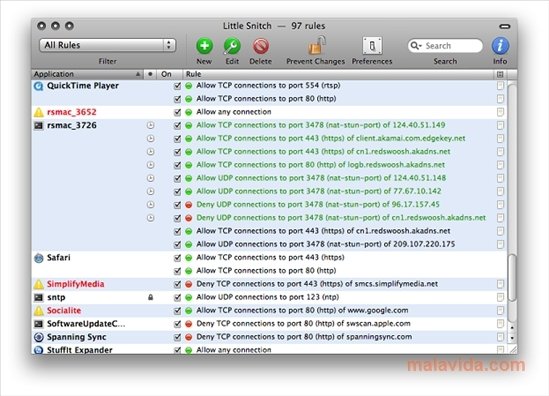
↓ 02 – Little Snitch 3 Network Monitoring € 29.95
Firewall for incoming connections. Little Snitch not only reveals any outgoing network connection attempt to make sure that sensitive data doesn’t leave your computer without your consent. The inbound firewall in Little Snitch provides you with the same level of control for incoming connections.
↓ 03 – Murus Lite App OS X Firewall Unchained FREE
Murus Lite is the entry level firewall front end. Everybody can download it and use it for free. It features inbound filtering and logging and can be used to protect services running on the Mac. Despite being free Murus Lite is not a tryout or demo. It is a full featured app and is a good starting point for the novice user.
- Inbound filtering
- Inbound logging
- Expanded PF Config.
- Ports Management
↓ 04 – Radio Silence Firewall For Mac USD9
Radio Silence is a tiny firewall that lets you block any application from accessing the internet. It is designed for people who are not interested in configuring traditional firewalls. Radio Silence supports OS X Yosemite, Mavericks, Mountain Lion, Lion, and Snow Leopard. It only takes a few seconds to install.
- 100% Annoyance-free – Radio Silence respects your concentration. That is why it will never interrupt you with pop-up windows or alerts.
- Zero Maintenance – Once the firewall is installed, you can forget all about it. It is always on and needs no attention from you.
- Tiny and Fast – Radio Silence weighs next to nothing. It doesn’t waste any time or resources, which also makes it blazingly fast.
- Usable by Anyone – You don’t have to be a network expert to use this firewall. It takes care of all the technical details for you.
How to Turn on Firewall Security on Apple Mac OS
The Mac firewall is turned off by default, no reason given by Apple why they did not enabled it by default. It is always better to be safe than sorry, therefore there is nothing to lose by enabling it, especially if your router has no Hardware Firewall capability.
Step 1 – Go to ‘System Preferences‘, click on ‘Security & Privacy‘.
Step 2 – On the Security & Privacy window, click on the ‘Firewall‘ tab.
Step 3 – To turn on the firewall security feature, you will need to unlock it. To unlock this settings window click on the padlock in the bottom left corner of the window. Set the password to unlock it.
Step 4 – With the Firewall feature unlocked, click on the ‘Turn On Firewall’ button. Congratulation, the firewall on the Apple Mac OS X is now enabled.
Mac Computers Fall Prey to Flashback Trojan
With the ever-growing volume of malicious software attacks on Mac computers, Mac users no longer feel their computers are safe from Internet security risks. The Flashback Trojan virus has affected over 700,000 users. Find out if your Mac is infected – and discover how to protect against Flashback and Mac OS X malware attacks.
Recommended for you:
If you have been using Little Snitch before, you probably know the situation: A connection alert asks you whether to allow or deny a connection, but you have no idea what that process is good for. Is this process part of the system? Is it a third party software component? Why does it want to connect to this particular server? An answer to this question often requires profound Internet research.
To save you from this tedious task, we provide the results of our own research available in an online database.
Zoom Udp Connections Little Snitch Free
Obtaining information
The database is only contacted on explicit request of the user:
This additional click protects your privacy: Connection data is only sent to Objective Development on explicit request, not for every line in Network Monitor or Little Snitch Configuration when you step through the list.
Before the assistant can be used, a rule allowing access to an obdev.at server must be created. /plugin-vst-piano-download.html. The first time you attempt to query our research database, Little Snitch will ask you whether to enable the service and to create the rule. If you later want to revoke the permission, simply disable or delete the respective rule for the Little Snitch Helper process.
How does it work?
When you click the button to query our database, a URL request (a GET request) is sent to our database server. The request contains all connection properties so that the information we provide can be as specific as possible:
Zoom Udp Connections Little Snitch Game
| INFO | DESCRIPTION |
|---|---|
| Language | The preferred language you have chosen in System Preferences so that we can respond in the correct language, if available. We currently provide information in English and German. |
| Incoming | Whether this is an incoming our outgoing connection. |
| macOS Version | Version of your macOS installation. Some system daemons behave differently on different versions of the operating system, so it may be useful to have specific information available. |
| Bundle Identifier | If the process is an application, it has a bundle identifier which uniquely identifies it. This field is empty for non-application processes. |
| Executable Path | The full path of the process executable in the file system. |
| Localized Name | For applications, the app name localized to your language. We don’t use this for matching database entries, but may need it when we research a frequently requested app. |
| Via-Path | If an application performs the request via a Unix command, the full file system path of the Unix command. |
| Server | The remote server’s DNS name (if available) or IP address (otherwise). |
| Port | The connection’s destination port number for TCP and UDP, 0 for other protocols. |
| Timestamp | The current time in low resolution. |
| Signature | A short signature. Timestamp and signature are there to sort out invalid requests before any database query is done. This is a first level of protection from online attacks. |
Zoom Udp Connections Little Snitch Lyrics
The response is the database entry in XML format, prefixed with a signature.
Zoom Udp Connections Little Snitch 2
Which information about queries is stored?
We (Objective Development Software GmbH) collect statistics about which connection is requested frequently, so we can add information for those records. We do not store any information in our database that could identify you. In fact, requests with the same set of parameters (except timestamp and signature) are merged into a single database record. Your IP address is only stored in standard web server logs, which are rotated regularly.
Was this help page useful? Send feedback.
© 2016-2020 by Objective Development Software GmbH